Showing posts with label creative destruction. Show all posts

June 12, 2021

Central banks and regulators cancelled the creative part of destruction.

I refer to Martin Wolf’s comments on Philippe Aghion, Céline Antonin and Simon Bunel’s “The Power of Creative Destruction”, “The innovation game” FT June 11, 2021 

John Kenneth Galbraith in “Money: Whence it came where it went” of 1975 wrote: “For the new parts of the country [USA’s West]…there was the right to create banks at will and therewith the notes and deposits that resulted from their loans…[if] the bank failed…someone was left holding the worthless notes… but some borrowers from this bank were now in business...[jobs created]” That’s creative destruction in action.

The current risk weighted bank capital requirements allow banks to earn much higher risk adjusted returns on equity when financing what’s perceived (or decreed) as safe e.g., loans to the government and residential mortgages, than when lending to the “risky” small businesses and entrepreneurs. That’s creative destruction inaction. 

Would the development Galbraith describes have been possible with these regulations? No! Such risk-averse regulations do not help promote innovations.

Sir, in august 2006, in reference to an FT editorial mentioning the possibilities and impact of a “global housing slowdown”, you published a letter I wrote in which I referred to “The long-term benefits of a hard landing.” When the global financial crisis erupted in 2008, there was too much interest in trying to avoid collecting any of these benefits, and the crisis-can was kicked forward... and then much upward with QEs. 

The result? Way too little creative destruction and way too many surviving zombies… and here we are, on a much higher mountain of public and private debt. That will cause pure destruction.

“Risk weighted bank capital requirements”. Sir, if that’s not sophisticated technocratic demagoguery, what is?

December 13, 2011

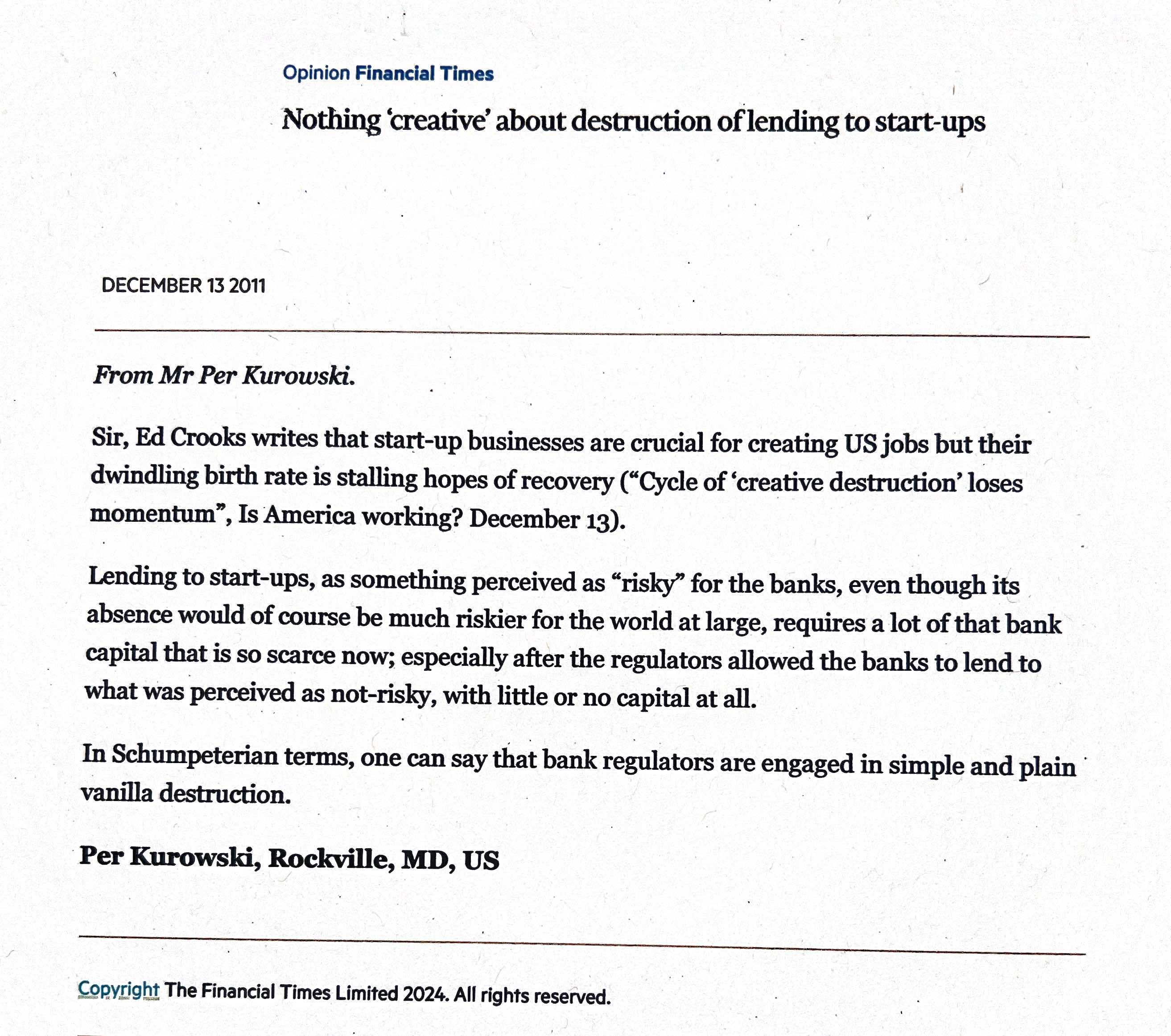
Nothing ‘creative’ about destruction of lending to start-ups

Published in FT, December 14, 2011

Sir, Ed Crooks writes that start-up businesses are crucial for creating US jobs but their dwindling birth rate is stalling hopes of recovery "Cycle of 'creative destruction' loses momentum to start-ups", Is America working? December 13).

Lending to start-ups, as something perceived as “risky” for the banks, even though its absence would of course be much riskier for the world at large, requires a lot of that bank capital that is so scarce now; especially after the regulators allowed the banks to lend to what was perceived as not-risky, with little or no capital at all.

In Schumpeterian terms, one can say that bank regulators are engaged in simple and plain vanilla destruction.


May 07, 2009

Do not undercut in any way the disciplinarian role of the market

Sir as an Executive Director at the World Bank 2002-2004 and as member of its Audit Committee I remember as one of my biggest frustrations continuously warning about counterparty risks and always ending up being answered along the lines of... “What counterparty risks? Don’t you know that a triple-A is a triple-A is a triple-A?”

This is why I take strong exception when Matthew Richardson and Nouriel Roubini in “Insolvent banks should feel market discipline”, May 7, though correctly advocating more of Schumpeterian creative destruction, are surprisingly lenient in the case of counterparty risk. They even write “But unlike with Lehman, the government can stand behind any counterparty transaction”. No!

What is counterparty risk? The risk that for example the insurance company you have insured yourself with cannot pay up when it should. This risk is clearly not a risk that an ordinary citizen should have to bear but for the financial system’s overall health it is an absolute must that all the qualified institutional participants bear with the full consequences of it.

In fact, in case they have not read it, current third pillar of the otherwise so discredited bank regulations from Basel – named the market discipline, “aims to encourage market discipline by developing a set of disclosure requirements which will allow market participants to assess key pieces of information on the scope of application, capital, risk exposures, risk assessment processes, and hence the capital adequacy of the institution.” And that of course means the evaluation and the taking of counterparty risks.

And by the way, just as the markets would benefit from more creative destruction, let me also remind you that so would our financial regulators