Showing posts with label start-ups. Show all posts
January 27, 2017
Sir, Martin Wolf writes: “UK’s future income will depend on rising output per hour” “The productivity challenge to the British economy” January 27.
To be able to increase productivity is not a God given right. In general it requires a lot of risk-taking, like loans to SMEs, entrepreneurs and start-ups. The risk weighted capital requirements for banks represents a big effective wall against such risk taking. But on that Wolf has steadfastly kept mum.
PS. I dreamt last night that I had finally gotten an answer from the regulators on my questions… but then I woke up L
@PerKurowski
January 20, 2017
Why has Ms. Tett waited until now when President Trump is inaugurated to so champion the importance of start-ups?
Sir, for me it is somewhat surprising to read Gillian Tett’s “Start-ups will make America great again” January 20. Of course she is correct in what she writes there, but why did she have to wait until now for recommending Trump to “think small — in a big(ly) way”?
I ask because over the last decade I must have written at least a 100 letters in commenting on Ms. Tett’s articles I have argued the vital importance for the real economy and job creation, of the start-ups and SMEs; and also how risk weighted capital requirements for banks distorts the allocation of bank credit, effectively reducing bank credit availability for those perceived as risky, like SMEs, like start ups. But, during all those years Ms Tett has kept mostly silence on this, and so why right now?
Why has she also not told Mark Carney, Mario Draghi, Stefan Ingves and so many others about this? If in USA, SMEs and entrepreneurs have since Basel II of 2004 found it harder than ever to access bank credit, even worse are the conditions these borrowers have to face in Europe. And by the way, when will Ms Tett also remind those gentlemen who are all involved in bank regulations, that these SMEs / start-ups really never pose major dangers to the bank system, and that precisely because they are ex ante perceived as risky?
Since the introduction of Basel II millions of SMEs, entreprenuers and similars around the world have been denied the opportunity to that bank credit that could have helped our young to find jobs and not have to settle to live with their parents in basements. Well-done Basel Committee!
Finally, does Ms. Tett really need researchers from McKinsey to wake her up on what robots or automation could signify to jobs in general… is this really new news? And where has McKinsey spoken out against regulatory distortion of credit?
@PerKurowski
April 29, 2015
Who is more risky, a Systemic Important Financial Institution, or a Systemic Important One and Only Regulator?
Sir, Richard Allan, Facebook’s vice-president of public institutions in EU, complains about “having to comply with 28 independent shifting national variants” of regulations, “European discord on the internet is bad for business."
It is not that I claim to know about European regulations that affect Facebook, but, if one is able to justifiably warn about a Systemic Important Financial Institution, a SIFI, then one also has the right to warn about a Systemic Important One and Only Regulator?
And I would leave it there, were it not for Allan writing: “The biggest victims [of national regulations] would be smaller European companies. The next big thing might never see the light of day. We know from experience that getting a company off the ground is hard enough already. And if regulation at the national level is adopted, it could stop start-ups before they even get started. At a time when Europe is looking to create jobs and grow its economies, the results could be disastrous.”
And that made me mad. No national bank regulator would have dared to come up with regulations like the current risk-weighted equity requirements for banks, and that so negatively affects the fair access to bank credit of the “risky”, like the start-ups. For instance the reason for which a Greek bank needs to hold much more equity when lending to a Greek start-up, than when lending to the government of Germany, is precisely the existence of a big monstrous non-transparent and not accountable concoction as is the Basel Committee for Banking Supervision.
In short, if I was a small start-up, I would like the regulator to be small like me, and not one of those biggies who mostly go to Davos and meet with SIFIs and the likes of Facebook.
@PerKurowski
January 28, 2015
What would make a Negro slave on a cotton plantation in 1800 America, not feel being discriminated against?
Sir, I refer to Luke Johnson’s valedictory essay for the FT “A farewell after eight years championing founders” January 28.
The following Johnson writes is extraordinary: “I believe independent ownership of business assets is incredibly important if we want a vibrant economy. Founders possess animal spirits and optimism that contribute disproportionately to innovation, job creation and tax generation. They are the essential ingredient for a more prosperous society, together with the rule of law and sound property rights. These inventors, mavericks and would-be tycoons exist to take risks most of us seek to avoid in our careers.
Start-ups renew industry and society, and pioneer and implement new technology that established institutions shun, because it would upset their cosy oligopolies. Crony capitalists — whose annual conference was held last week in Davos — are not entrepreneurs, but corporate managers who hate free markets and the idea of proper competition, while squandering most of their time on office politics and games of patronage.”
How extremely sad then that Luke Johnson completely missed out on how bank regulators, with Basel I favoring the “infallible sovereigns”, and with Basel II favoring the AAArisktocracy… impeded the fair access to bank credit of his “risky” risk-taking entrepreneurs.
What is it that makes those who should most see a distortion and discrimination in order to fight it, not seeing it?
July 30, 2014
Luke Johnson. Who would be your favorite contender for the title of the mother of all start-up slayers?
Sir I would not argue one iota with Luke Johnson’s “Contenders for patron saint of start-ups” July 30.
That said it would be interesting to see who he opines is the number one contender for start-ups' slayer?
Clearly it has to be one prominent bank regulators, like Mario Draghi, Stefan Ingves, Mark Carney, Jaime Caruana or any other of those who concocted the venom against star-ups we know as the risk weighted capital requirements for banks.
Because of that the start-ups, usually perceived as “risky”, relatively to those perceived as “safe”, now have to pay even higher interest rates, get even smaller bank loans and have to accept even harsher terms than they used to.
And sadly the only result of that mumbo-jumbo regulation is that now our banks run the risks of too much exposure to what seems absolutely safe, while renouncing to the benefits of diversifying when lending to those who seems risky.
There is Sir, as you surely must understand, no future in such silly risk-aversion!
June 30, 2014
Poor Shinzo Abe. Has no one told him Japan as a member of G10 also signed up on Basel II’s risk-aversion?
Sir, Shinzo Abe, Japan’s prime minister with respect to the goal of achieving economic growth in Japan writes: “We are restoring Japan’s venture spirit, creating opportunities for start-ups to bid for government contracts, opening markets and promoting new entrants in areas including energy agriculture and medical services”, “My ‘third arrow’ will fell Japan’s economic demons” June 30.
I almost feel sorry for him. Has no one told him that Japan, as part of the G10, signed up on Basel II, those bank regulations that has it as its pillar, that all who are perceived as risky, like start-ups and new entrants usually are perceived, shall NOT have fair access to bank credit, because this is believed to promote the stability of the financial system?
With such an opposition, there is little Shinzo Abe, or anyone else for that matter can do, no matter how good the intentions.
December 07, 2013
It is not voluntarily that European banks are abandoning the private sector in order to take refuge in the government.
Sir, I refer to John Dizard’s “Risk of a European break-up has not marginally disappeared”, December 7.
In it Dizard writes about “the collapse of private sector lending, which in the euro area as a whole has declined for more than a year and a half. That money had to go somewhere… ‘risk-free’ government paper has been a perfect place for the banking system to stuff the cash they are not lending to companies”. Dizzard makes it sound like this was a voluntary normal market based rational decision by the banks. It was not!
It is only the result of extremely distorting bank regulations which require banks to have a lot more of that capital they are currently so lacking of, when lending to the “risky” private sector, than when lending to the “infallible sovereign”.
Dizzard argues the European banking system is being “renationalized” but the sad reality is that banks are de facto being turned into statist government agents… and unfortunately we all know what happens to economies when their financing goes down that line.
December 04, 2013
When are they going to fine the bankers and not, suicidally, fine the banks?
Sir, right now, when the European banks are leveraged to the tilt and unable, because of faulty capital requirements and lack of capital, to finance those in the real economy most in need of bank credit, we read, reported by Alex Barker and Daniel Schäfer that “Brussels poised to announce hefty rate-fixing fines on global banks” December 4.
When are they going to fine the bankers and not the banks? Don´t they know that in these days of so little bank capital, derived from regulators requiring so little bank capital with Basel II, that every fine a bank pays, translates into less bank credit… primarily to those medium and small businesses entrepreneurs and start-ups we most need to have access to bank credit in competitive terms?
October 11, 2013
Current economic growth is not based on risk-taking but on risk-aversion, and therefore creates more fat than muscles
Sir, I refer to your Special Report on the World Economy, October 11.
While bank regulations that make it harder for medium and small businesses, entrepreneurs and start-ups to access bank credit are not eliminated, and regulators stop insisting on that banks shall only lend to the “infallible” sovereign, the housing sector and the AAAristocracy, any economic growth will only be of the type that leads to obesity.
August 28, 2013
Much of our nations’ “desire and dreams” were killed in the laboratories of bank regulators
Sir, Luke Johnson quotes Professor Edmund Burke, from his book “Mass Flourishing” believing “that the ‘glorious history of desire and dreams’ has run out of steam”, “The small start-ups are as vital as the starts” August 28.
Of course it has. How could it not, with bank regulators who allow banks to finance the “absolutely infallible”, the AAAristocracy, against much less capital than when lending to the small risky start-ups… and which means that the banks will earn a much higher risk adjusted return on equity when lending to the former, than when to the latter.
As I had the opportunity to do in a letter yesterday I would also suggest Luke Johnson to compare today’s banking with how, in Mary Poppins, Mr. Banks and his colleagues describe their Fidelity Fiduciary Bank
If you invest your tuppence, wisely in the bank, safe and sound
Soon that tuppence, safely invested in the bank, will compound
And you'll achieve that sense of conquest, as your affluence expands
In the hands of the directors, who invest as propriety demands
You see, my friend. You'll be part of railways through Africa.
Dams across the Nile. Fleets of ocean greyhounds.
Majestic, self-amortizing canals. Plantations of ripening tea
All from tuppence, prudently, fruitfully, frugally invested.
We used to pray for in our churches “God make us daring!” Clearly our bank regulators never attended mass.
August 21, 2013
“Why has the Fed given up on America’s unemployed?”, is a question that is at least a decade late
Sir, Adam Posen, the president of the Peterson Institute for International Economics asks, “Why has the Fed given up on America’s unemployed?”, August 21.
He should have asked that long ago, because when the Fed, as a bank regulator, accepted the thesis that banks could have much lower capital requirements when holding exposures to the “absolutely safe” AAAristocracy, than when lending to the “risky” medium and small businesses, entrepreneurs and start-ups, the Fed helped to impose regulatory risk-aversion, and thereby gave up on the risk taking needed to keep the real economy producing jobs.
August 12, 2013
Regulators did not worship at the altar of the new financial capitalism, they helped to build it
Sir, Philip Stephens writes that central bankers “failed dismally [in regulating banks]… during the years before the crash. Their mistake was – all would be well if markets were allowed to operate freely”, “Summers or Yellen? The best Obama can do is toss a coin”, August 12.
And that is precisely the kind of misunderstanding of what really happened which impedes us to move forward.
The regulators, by means of Basel II stopped the banks from leveraging more than 12.5 to 1 when lending to those considered “risky”, like the medium and small businesses, entrepreneurs and start-ups, but allowed the banks to leverage their equity 62.5 times to 1, or even more, when lending to what was considered “absolutely safe”, like to the "infallible sovereigns" and the AAAristocracy.
Frankly, does that have anything at all to do with allowing markets to operate freely? Of course not! Regulators did not worship at the altar of the new financial capitalism, they helped to build it, when an overdose of hubris led them to believe they could and should be the risk-managers of the world… and which is precisely that type of “invested with supernatural qualities” problem Stephens refers to.
The sad truth is that if central bankers are now the new masters of the universe, then we’ve got ourselves some really shitty masters, and we better watch up. Really, how can one feel comfortable with a Mario Draghi, who acting as the chair of the Financial Stability Board, saw nothing wrong in banks lending to Greece holding only 1.6 percent in capital/equity?
PS. If Obama heeds Stephens´ advice he better allow a very innocent hand to toss a very well examined coin, live in a TV show. Otherwise no one in this skeptical world would believe the outcome was in the hand of God… and even so.
July 29, 2013
More capital-equity against what is least likely to pose a risk to the bank system is the pillar of Basel II and III
Sir, Edward Luce in “Betting on start-ups can revive a tired presidency” July 29 writes “the effective equity cushion at the largest US banks is between 4 and 6 per cent of their balance sheet. For the small Main Street banks that still make “character loans” – lending money to customers they know – that cushion is 9 per cent. In other words, US regulators are twice as strict with those banks that are least likely to pose a risk to the system.”
That is not a US problem only as in Europe it is even worse. The Basel Committee is in this respect much worse than the US Federal Reserve, FDIC and the Office of the Comptroller of the Currency. The pillar of Basel II and III bank regulations are capital requirements based on perceived risk, which precisely forces bank to hold more capital-equity for what is perceived as risky and is therefore not that risky.
This is the problem that I have written about the Financial Times more than a thousand letters but which you have ignored, presumably because someone did not like something I wrote and decided I should be ignored-censored.
December 13, 2011
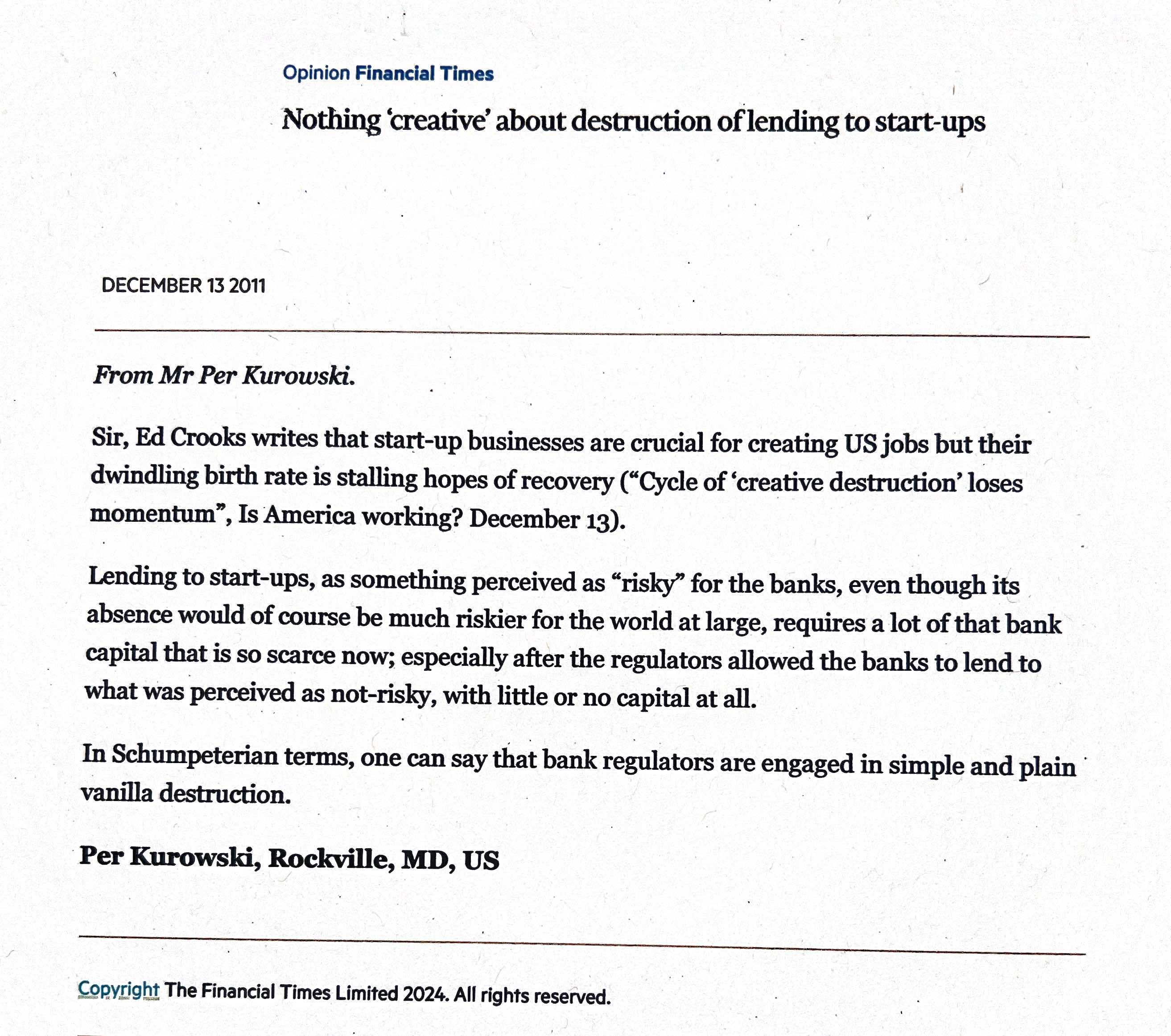
Nothing ‘creative’ about destruction of lending to start-ups
Published in FT, December 14, 2011
Sir, Ed Crooks writes that start-up businesses are crucial for creating US jobs but their dwindling birth rate is stalling hopes of recovery "Cycle of 'creative destruction' loses momentum to start-ups", Is America working? December 13).
Lending to start-ups, as something perceived as “risky” for the banks, even though its absence would of course be much riskier for the world at large, requires a lot of that bank capital that is so scarce now; especially after the regulators allowed the banks to lend to what was perceived as not-risky, with little or no capital at all.
In Schumpeterian terms, one can say that bank regulators are engaged in simple and plain vanilla destruction.
Subscribe to:
Posts (Atom)